
Please select the appropriate button below to go the portal login based on your service need.

2025 Nurse Migration Report
2025 Nurse
Migration Report
Rising mobility, rapidly changing dynamics,
and a need for global solutions
Executive summary
In the context of global shortages of healthcare professionals, nurse migration can be seen as a challenge and an opportunity, both for countries and for individual nurses. Despite challenges such as inequitable distribution, recognition of professional qualifications, and ethical recruitment, nurse migration plays an important role in developing a truly global healthcare workforce. Nevertheless, there is no permanent global, multilateral forum dedicated to this issue.
While the United States continues to be one of the top destinations for migrant nurses, there is an observable decrease of applicants for visas over the past 2-3 years. In contrast, an increasing share of foreign-educated nurses are finding work in Europe (representing now 8.01% of the European healthcare workforce, as compared to a ten-year average of 5.96%) and Southeast Asia (now 24.87% of the healthcare workforce, as compared to a ten-year average of 20.15%), thus shifting traditional migrating patterns.
Migration involves obstacles and challenges before, during, and after an individual moves from one country to another. Country-level immigration policies and practices vary along a spectrum from open and welcoming to restrictive and hostile toward immigrants. Health workers are not exempt from these. Some of the difficulties migrating nurses face include lack of professional support, language and communication difficulties, destination countries not meeting migrant expectations, discrimination, and lack of cultural integration and feelings of belonging.
In addition to those difficulties, there are areas of emerging focus bringing new challenges for governments, regulators, and migrating nurses, including the need for global certifications that recognize nurses’ value, knowledge and experience; involuntary migration; competency-based education; mutual recognition and credential portability; occupational fraud and system security; and ethical recruitment.
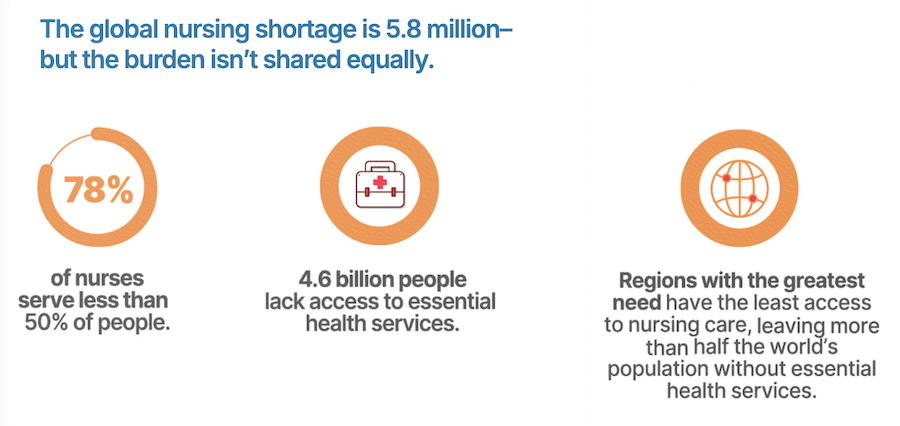
Care model evolution will have a significant impact on nurse migration. The use of new technologies will change the pull and push factors by creating demand for new skills and shifting roles between modalities of care.
This report builds on efforts by several organizations and institutions to bring together the most recent and up-to-date data on nurse migration. However, there is a global lack of consistent and quality data preventing more in-depth analysis and better policy development.
In light of all these issues, this report provides several policy recommendations that could improve the life of millions of migrating nurses worldwide.
Get your copy today.
Download your free copy today.
Press or media?
Download our media briefing sheet for this report and more.