
Please select the appropriate button below to go the portal login based on your service need.

Determining Nursing Education Comparability
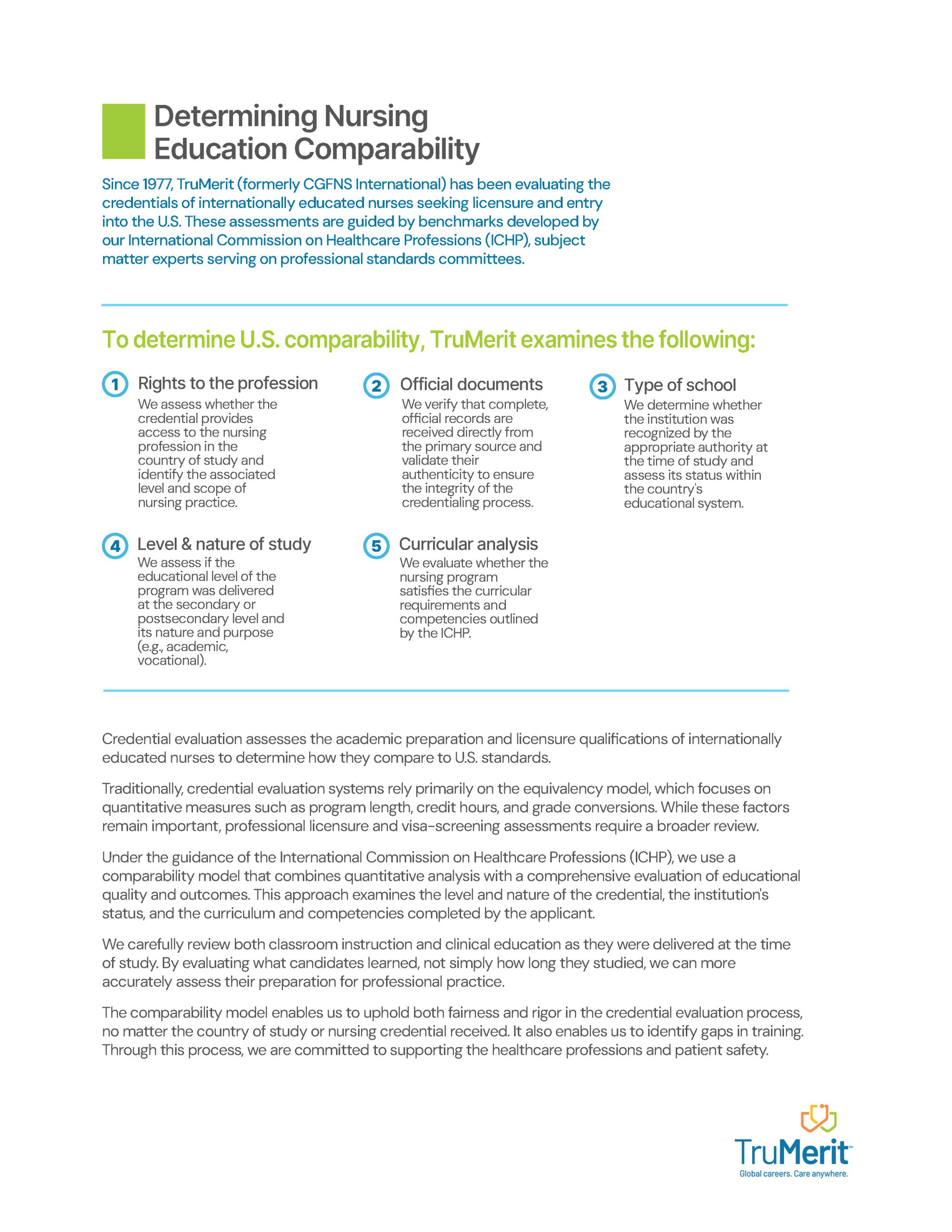
Since 1977, TruMerit (formerly CGFNS International) has been evaluating the credentials of internationally educated nurses seeking licensure and entry into the U.S. These assessments are guided by benchmarks developed by our International Commission on Healthcare Professions (ICHP), subject matter experts serving on professional standards committees.
To determine U.S. comparability, TruMerit examines the following:





Credential evaluation assesses the academic preparation and licensure qualifications of internationally educated nurses to determine how they compare to U.S. standards.
Traditionally, credential evaluation systems rely primarily on the equivalency model, which focuses more heavily on quantitative measures such as program length, credit hours, and grade conversions. While these factors remain important, professional licensure and visa-screening assessments require a broader review.
Under the guidance of the International Commission on Healthcare Professions (ICHP), we use a comparability model that combines quantitative analysis with a comprehensive evaluation of the educational outcomes. This approach examines not only the level and nature of the credential and the institution’s status, but also the curriculum and competencies completed by the applicant.
We carefully review both classroom instruction and clinical education as they were delivered at the time of study. By evaluating what candidates learned, we can more accurately assess their preparation for professional practice.
The comparability model enables us to uphold both fairness and rigor in the credential evaluation process, no matter the country of study or nursing credential received. It also enables us to identify gaps in training. Through this process, we are committed to supporting the healthcare professions and patient safety.